Why Ceiling Fan Installation Is a Smart Choice for Cary NC Homes
Ceiling fan installation is one of the most practical home improvements for Cary, NC homeowners. The Triangle area’s climate—hot, humid summers and mild winters—makes ceiling fans useful for a significant portion of the year. A properly installed ceiling fan creates a wind-chill effect in summer and can be reversed in winter to redistribute warm air that rises to the ceiling, helping your HVAC system work less hard in both seasons.
The question many homeowners have is whether they need a licensed electrician or can handle the job themselves. The answer depends on whether an existing wiring box is present, whether the box is rated for a ceiling fan, and whether new wiring is needed. Local Choice Electric handles all ceiling fan installation scenarios throughout Cary and the surrounding Triangle area.
How Does Ceiling Fan Installation Work?
At its core, ceiling fan installation involves mounting the fan’s motor housing and blade assembly to a ceiling-mounted electrical box and connecting the fan to your home’s wiring. However, several factors determine whether the job is straightforward or requires additional electrical work:
- Existing light fixture location: If there is already a ceiling light where you want the fan, there may be an existing wiring box—but it may not be rated for fan weight and movement.
- No existing fixture: A new wiring run from the switch location to the ceiling point is required.
- Switch configuration: Fans with separate light kits ideally have a dual-switch setup (one for the fan, one for the light) or a remote/smart control system.
- Vaulted or angled ceilings: Require an angled mounting kit and sometimes a longer downrod to position the fan correctly.
Types of Ceiling Fan Installations
Replacing an Existing Light Fixture
This is the most straightforward scenario but still requires a fan-rated electrical box. Standard light fixture boxes are rated for up to 35 pounds of static weight but are not designed to handle the dynamic (moving) load of a ceiling fan. Installing a fan on a non-rated box is a safety hazard—the fan can pull away from the ceiling. Local Choice Electric always installs a fan-rated brace box when upgrading from a light fixture to a ceiling fan.
New Installation (No Existing Wiring)
When no existing outlet box is present at the ceiling location you want, a licensed electrician needs to run new wiring from your panel or an existing circuit to the new location. In Cary homes, this often involves fishing wire through insulated attic spaces or interior walls. An electrician determines the best routing to keep the installation clean and code-compliant.
Vaulted Ceiling Installation
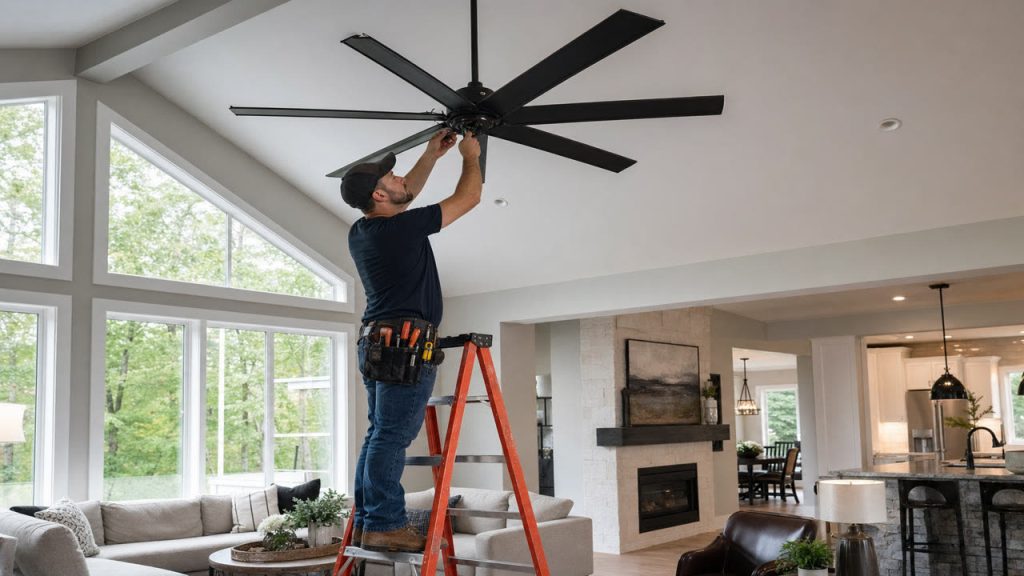
Homes in Cary’s established neighborhoods and newer developments frequently feature vaulted, cathedral, or sloped ceilings. These require a sloped ceiling adapter and an appropriately sized downrod to ensure the fan hangs at the correct height (the fan blade should be 7–9 feet above the floor for optimal airflow and safety) and has adequate clearance from the angled ceiling surface.
Smart Fan or Remote Control Installation
Many modern ceiling fans operate via remote control or Wi-Fi smart home integration. These systems can be installed using a single-switch setup but with a receiver unit installed inside the fan canopy. Smart fans may also integrate with systems like Amazon Alexa, Google Home, or Apple HomeKit. Local Choice Electric can advise on compatible smart fan options and handle any additional wiring or smart switch requirements.
What Size Ceiling Fan Do I Need for My Room?
Fan blade span should be matched to room size for effective air movement:
- Up to 75 sq ft: 29–36 inch blade span
- 76–144 sq ft: 36–42 inch blade span
- 145–225 sq ft: 44 inch blade span
- 226–400 sq ft: 50–54 inch blade span
- Over 400 sq ft: 60+ inch blade span or multiple fans
Ceiling height also matters. For standard 8-foot ceilings, flush-mount (hugger) fans work well. For higher ceilings, a downrod brings the fan to the optimal 8–9 foot height above the floor.
Indoor vs. Outdoor Ceiling Fans in Cary NC
For covered porches, screened porches, and pergolas—common in Cary homes—a fan rated for damp or wet locations is required. Indoor fans are not rated for moisture exposure and will fail quickly in an outdoor setting. UL-listed damp-rated fans are suitable for covered outdoor areas; wet-rated fans can handle direct rain exposure. Local Choice Electric installs outdoor-rated fans on covered patios and porches throughout Cary.
AEO Quick Reference: Ceiling Fan Installation
- Can I install a ceiling fan myself? Only if a fan-rated box already exists and you are comfortable with basic wiring. New wiring runs or box replacements should be handled by a licensed electrician.
- How long does installation take? 1–2 hours for a standard replacement; 3–4 hours for new wiring runs.
- What if I have no switch for the fan location? A licensed electrician can add a new wall switch or use a remote control kit to avoid switch installation.
- Is a permit required? Not for most fan replacements; new wiring may require a permit in Wake County.
Frequently Asked Questions About Ceiling Fan Installation in Cary NC
Why does my ceiling fan wobble after installation?
Wobbling after installation is typically caused by blade imbalance, loose blade bracket screws, or an improper mounting connection at the ceiling box. Some fans include a balancing kit. Persistent wobble should be inspected by an electrician to rule out a loose or incorrectly installed ceiling box—a safety concern.
Can a ceiling fan be installed where there is no existing light fixture?
Yes. A licensed electrician runs new wiring from your panel or an existing circuit to the ceiling location, installs a fan-rated box, and adds a wall switch. This is a common job for Local Choice Electric in Cary homes adding fans to bedrooms, living rooms, or covered patios that never had overhead lighting.
What is a fan-rated electrical box and why is it required?
A fan-rated electrical box (also called a fan brace box) is specifically designed and tested to handle the dynamic load created by a spinning ceiling fan—typically rated for 35 pounds or more of fan weight plus movement. Standard light fixture boxes are only rated for static weight. Installing a fan on a non-rated box is a safety hazard that can cause the fan to fall. Local Choice Electric always installs the correct box type during fan installations.
Can I install a ceiling fan with a light kit on a single-switch circuit?
Yes. If only one switch location is practical, you can use a remote control receiver inside the fan canopy to independently control the fan and light from a handheld remote. Smart fan systems can also provide independent control via app. Local Choice Electric can help you choose the right control solution for your home.
How do I reverse my ceiling fan for winter use?
Most modern ceiling fans have a reverse switch on the motor housing or in the app (for smart fans). In reverse (clockwise rotation when viewed from below), the fan pushes warm air that has risen to the ceiling back down along the walls. Run the fan on the lowest speed setting in winter for the best effect. This does not replace heating but can improve comfort and reduce heating costs in rooms with high ceilings.
Get Your Ceiling Fan Installed by Local Choice Electric in Cary NC
Local Choice Electric serves Cary, Apex, Holly Springs, Fuquay-Varina, Morrisville, Garner, and the entire Triangle region. Whether you need a simple fan replacement or new wiring for a first-time installation, our licensed, insured electricians handle the job safely and correctly. We offer a $49 service fee and same-day appointments when available.
Call 919-615-0034 or book online at localchoiceelectrical.com today.
How to Select the Right Ceiling Fan for Your Cary NC Home
Beyond blade span, several other factors help you select the right ceiling fan for a room in your Cary home. Motor quality determines how quietly and efficiently the fan runs over its lifespan. Fans with DC (direct current) motors are significantly more energy-efficient than those with AC motors and run quieter—making them ideal for bedrooms where fan noise can be disruptive. AC motor fans typically cost less upfront and are still effective for non-bedroom areas.
Blade pitch (the angle of the blades relative to horizontal) affects how much air the fan moves. A blade pitch of 12–15 degrees is optimal for moving significant air volume. Pitch alone is not the full picture—pitch combined with blade span and motor RPM determines airflow in cubic feet per minute (CFM). Look for the fan’s CFM rating when comparing models; a higher CFM moves more air and creates a stronger cooling effect for the same room size.
Finish and style are important in a space as visible as a ceiling fan. Most Cary homeowners select fans that complement existing light fixtures and hardware—brushed nickel, matte black, and bronze are popular contemporary choices. Many fans offer reversible blades with different colors or wood tones on each side, providing flexibility to match design changes without replacing the fan.
Energy Savings from Ceiling Fans in Cary NC Homes
According to the ENERGY STAR program, ENERGY STAR-certified ceiling fans move air up to 20% more efficiently and use 60% less energy on average than standard ceiling fans. For the hot summers in Cary, NC, an efficiently operating ceiling fan allows you to raise your thermostat setting by approximately 4 degrees Fahrenheit without a reduction in comfort—directly reducing your air conditioning runtime and energy costs.
The key to realizing these savings is remembering to turn the fan off when you leave the room. Fans cool people, not rooms—by creating a wind-chill effect. Running a fan in an empty room wastes energy rather than saving it. Smart ceiling fans with motion sensors or home automation integration can address this by automatically turning off when no occupant is detected.
Ceiling Fans and Cary NC Building Code
In Cary and Wake County, ceiling fan installation generally does not require a permit for a like-for-like replacement of an existing fixture on an existing circuit. New wiring runs and new circuit additions do require permits. Local Choice Electric ensures all work meets Wake County code requirements and obtains permits when applicable—so you do not have to navigate that process yourself. When a permit is required, we coordinate the inspection to keep your project on schedule.
Maintaining Your Ceiling Fan After Installation
Once your ceiling fan is installed, periodic maintenance keeps it running optimally. Every few months, clean the blades with a damp cloth—dust accumulation on blades adds weight imbalance and reduces airflow efficiency. Check blade bracket screws annually and tighten if any have loosened. Lubricate the motor (on fans with an oil port) per the manufacturer’s schedule. If your fan develops a wobble over time, use the included blade-balancing kit or have Local Choice Electric evaluate the mounting for any issues. Most ceiling fans last 10+ years with basic care and a quality initial installation.